





FAQs
Standard turnaround 5-15 business days.
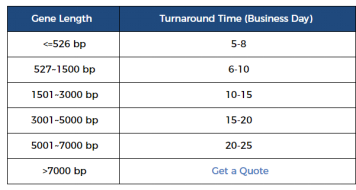
Yes. We have proven experience synthesizing challenging sequences, including high GC/AT content, homopolymers, and repetitive regions, with a success rate of over 99%.
All customer information will be kept confidential, strict NDA (Non-Disclosure Agreement), no third-party sharing.
FASTA, GenBank, SnapGene, plain text. Free format conversion available.
● 4 μg of lyophilized plasmid
● Sequence chromatograms covering your gene (e-version)
● Construct map of the plasmid (e-version)
● Quality assurance certificate
Compared with traditional PCR cloning method, gene synthesis is accurate and target products without affecting the subsequent verification of gene function.
Codon optimization can improve the expression and solubility of target protein.
The construction of tissue-specific cDNA library by common PCR cloning method is time-consuming and costly.
The gene synthesis turnaround time is fast and cost effective without relying on the template and enzyme restriction site.
Difficult gene sequences that cannot be obtained by traditional PCR cloning techniques but can be synthesized by gene synthesis.
Fast turnaround time: will be shipped starting from 8 days.
High quality delivery: 100% sequence accuracy guaranteed with sanger sequencing method.
Complex & difficult genes synthesis: expertise in synthesizing complex, GC-rich, repeated, or long genes.
Advanced codon optimization technology: GenCefe provides free codon optimization services.
Yes. Please contact our project managers to talk about the details of your project.
They are protective bases for blunt end ligation.
Lyophilized genes can be stored room temperature or -20℃. Once reconstituted, it needs to be stored at 4℃ for short term or -20℃ for long term.
Sequencing raw files, sequencing alignment, COA with restriction digesting analysis result, plasmid map.
The ab1 files are raw files of chromatogram, it can be opened by any sequencing analysis software such as DNAstar, sequencer, or chromas. The SDQ files are alignment which needs to be opened by DNAstar, we also print a PDF file of this alignment which can be opened by Adobe Reader.
Yes, we can try, but some companies will not sell vectors to a commercial entity due to license issue, if you are from academia, it is better for you to purchase it and ship it to us.
All molecular cloning services includes sequence verification.
GenCefe offers flexible plasmid preparation from microgram to gram scales. The appropriate scale can be selected based on your application and required quantity.
Yes. GenCefe can prepare plasmids synthesized by GenCefe or plasmids provided by customers, subject to initial quality assessment and project requirements.
Plasmid samples can be provided as dry samples on filter paper. DNA dissolved in an appropriate buffer can also be accepted when required.
Yes. Customized QC items can be included according to your project requirements. Please specify any required testing or acceptance criteria when requesting a quote.
For plasmids synthesized by GenCefe, the synthesized and inserted sequence is verified by sequencing as part of the standard QC process. For customer-provided plasmids, whole plasmid sequencing by third-generation sequencing is available upon request and may incur an additional charge.
Yes. Endotoxin removal is available according to project requirements and can be used for plasmid preparation intended for applications requiring low-endotoxin DNA.
Yes. GenCefe provides plasmid preparation suitable for transfection applications, with endotoxin-related requirements and other specifications considered according to the project.
Yes. Multiple plasmids can be included in a single project. Please provide the plasmid information and required quantities so that we can assess the project requirements and provide a customized quotation.
Yes. Buffer, concentration, and aliquot requirements can be discussed based on your project needs and service specifications.
Yes. Plasmid preparation can support downstream applications such as viral packaging, subject to the specific plasmid, quantity, quality, and application requirements.
Please provide the plasmid sequence or map, required preparation scale, intended application, preparation level, endotoxin requirements, desired concentration, and any specific QC or formulation requirements.
Gene fragments are in vitro-synthesized, double-stranded linear DNA fragments delivered directly to the customer. Unlike gene synthesis products that can be delivered as genes cloned into a vector, gene fragments allow customers to perform downstream cloning or assembly themselves.
Gene fragments can serve as DNA building blocks for downstream cloning, assembly, and other molecular biology workflows where a linear DNA fragment is required.
Yes. Gene fragments are provided as linear DNA, allowing you to perform downstream cloning or assembly into your desired vector or construct according to your project requirements.
Yes. Multiple gene fragments can be used together for projects requiring assembly of larger DNA constructs. Please provide the relevant sequences and project requirements when requesting a quote.
Please provide the target DNA sequence, required fragment specifications, quantity, and delivery destination. Additional project information can be provided if specific downstream assembly requirements need to be considered.
Codon optimization is commonly used for recombinant protein and antibody expression, particularly when a gene is expressed in a host with different codon usage preferences from its native organism. Optimizing the coding sequence for the selected expression host can help support efficient protein expression.
No. Codon optimization changes the synonymous codons in the coding sequence while maintaining the intended amino acid sequence of the target protein.
GenCefe provides host-specific codon optimization for a broad range of expression hosts, including bacteria, yeast, plants, and mammalian cells. Optimization strategies are selected according to the expression host and project requirements.
Please provide the target gene sequence and selected expression host. Additional information about the intended expression system or downstream application can also help us develop an appropriate optimization strategy.
Yes. Codon optimization is integrated into GenCefe's gene synthesis workflow and can be performed as part of the sequence design process before gene synthesis.
Yes. Codon optimization can be applied to antibody-related coding sequences for recombinant expression. The optimization strategy can be tailored to the selected expression host and the specific antibody construct.
Codon optimization is designed to support efficient protein expression, but expression outcomes depend on multiple factors, including the gene sequence, construct design, expression host, and experimental conditions. GenCefe's optimization strategies have been evaluated through internal testing and customer projects, with multiple cases demonstrating significant improvements in recombinant protein expression levels.
Yes. Codon optimization is provided free of charge as part of GenCefe's gene synthesis service, using our proprietary algorithms and AI-assisted technology.
If we cannot deliver the product, you will not be charged. If we can deliver a partial construct, you will need to pay for the part of the work that is performed.
We send order summery to customer and will need customer to confirm by replying the email. This is to make sure the order information is correct before project starts. Confirmation is required for molecular biology orders.
If the order is not confirmed you can change or cancel it at anytime; once the order is confirmed there will be a charge if you want to change or cancel. You need to contact your project manager to change/cancel orders.
Yes, if you have a FedEx account, we can use it for the shipping, but handling fee will be charged.
Subcloning typically involves transferring a target gene or DNA fragment from an existing construct into a different vector or construct. PCR cloning uses PCR amplification to obtain the target DNA fragment, followed by cloning it into the specified vector. The appropriate approach depends on the available DNA template, target sequence, vector, and cloning requirements.
Yes. GenCefe can work with customer-provided vectors and develop a suitable cloning strategy based on the target gene, vector features, and project requirements. Please provide the relevant vector information and target sequence for technical evaluation.
Yes. Target genes can be cloned into designated sites within specified vectors according to project requirements. Our technical team can evaluate the target sequence, vector, and intended cloning site and recommend an appropriate cloning strategy.
If the target gene is not available, GenCefe can support gene synthesis as part of an integrated gene-to-plasmid workflow. If you have a specific vector requirement, you can provide the vector information or a customer-provided vector for project use. Our technical team can evaluate the available materials and recommend a suitable approach.
Yes. GenCefe's technical team has experience with a broad range of commercial vectors and can develop customized cloning solutions for complex project requirements. Please provide the target sequence, vector information, and relevant cloning requirements so that our technical team can evaluate the project and recommend an appropriate strategy.
We offer synthesis of various RNA types including siRNA, miRNA mimics/inhibitors, sgRNA, pegRNA, circRNA, shRNA, mRNA, and long non-coding RNA (lncRNA).
We currently support RNA synthesis up to 300 nucleotides. For longer RNA such as IVT mRNA, please refer to our mRNA synthesis service.
Yes. Our siRNA is synthesized as a duplex and delivered pre-annealed, ready for use. Single-stranded RNA is available upon request.
We synthesize sgRNA as single-stranded RNA, with optional inclusion of the scaffold region. We can produce long sgRNA sequences (e.g., 100–120 nt) according to your design.
For standard-length unmodified RNA (e.g., siRNA, sgRNA), turnaround is typically 4–5 business days. Modified or long RNA may take longer time depending on sequence and complexity.
Yes. All RNA products come with molecular weight (MV) verification by LC-MS. Additional QC reports can be provided upon request.
RNA is delivered lyophilized by default. Store at –20°C and avoid repeated freeze-thaw cycles.
1) After receiving the lyophilized RNA powder, please DO NOT open the tube cap immediately. Centrifuge the tube for 1-2 minutes to concentrate the RNA powder at the bottom of the tube.
2) Open the tube cap in the clean bench. Add an appropriate amount of RNA dissolving solution or RNase free H2O into the tube.
3) Immediately place the centrifuge tube containing RNA on ice for 0.5-1h to fully dissolve the RNA.
4) Quantify the RNA for standby use.
5) If multiple uses are required, it is recommended to aliquot the RNA solution as needed. Store the RNA solution at -80℃ and avoid repeated freezing and thawing.
6) Lyophilized RNA powder should be stored below -20'C.
Note: All operations on RNA should avoid RNase contamination, and masks, gloves and protective clothing should be worn. Use RNase-free consumables and reagents.
Group | Operation | Purpose |
Blank control group | Cell culture, no treatment | Monitor cell growth |
Transfection reagent group | Transfection reagent only | Assess the toxicity of transfection reagent |
siRNA NC group | Transfect siRNA NC | Prove the specificity of siRNA |
siRNA 1-3 group | Transfect target gene siRNAs | Knockdown of target gene |
Positive control group | Transfect positive control si-GAPDH | Validate knockdown process |
Fluorescence control group | Transfect fluorescent control | Detect transfection efficiency |
GenCefe provides fluorescent controls labeled with FAM, Cy3, and Cy5, usually FAM.
● FAM has a maximum absorbance at 495nm and a maximum emission at 520nm.
● Cy3 has a maximum absorbance at 550nm and a maximum emission at 565nm.
● Cy5 has a maximum absorbance at 643nm and a maximum emission at 667nm.
After 24-48 hours of transfection, it can be observed using a fluorescence microscope and a confocal microscope. Pay attention to light protection during the transfection operation and culture process. Other operations are the same as siRNA.
In general, it is the toxicity of the transfection reagent to the cells. You can reduce the amount of transfection reagent, or use other transfection reagents or transfection methods; you can also try to reduce the amount of siRNA. If the cell itself is not in good condition, it is recommended to re-experiment and re-recover the cells if necessary.
No strict benchmark. The interference efficiency varies with different cell types and different genes. The transfection efficiency of different cell types is also different, and the expression levels of different genes also vary greatly, mainly due to the interference effect.
There are mainly two reasons:
● Low transfection efficiency-It is necessary to optimize the transfection reagent and siRNA dosage, or replace the transfection reagent to improve the transfection efficiency;
● Poor siRNA target design – If it is determined that there is no problem with the transfection efficiency, the siRNA target may need to be redesigned.
After using mimic, qPCR can be used to verify the overexpression of miRNA, but inhibitor is not applicable. In principle, inhibitor binds to miRNA and inhibits the function of miRNA, and it does not change the expression of miRNA. Its effect can be detected by detecting the protein expression level of the target gene or by the luciferase reporter system.
Agomir and antagomir may have a certain impact on qRT-PCR due to the addition of chemical modifications, and the effect of use cannot be verified by qPCR method. Agomir can detect miRNA expression through Northern Blot, and antagomir can verify its effect by detecting the expression of the target gene of miRNA
It CANNOT be used universally because mimic/agomir is double-stranded RNA and inhibitor/antagomir is single-stranded RNA.
It is recommended to use NC as a control group to exclude false positive results that may be caused by stress.
GenCefe offers flexible RNA synthesis services covering a broad range of RNA lengths and production scales. Using chemical synthesis technologies, RNA oligonucleotides can typically be synthesized up to 150 nt, depending on sequence complexity and modification requirements. For longer RNA constructs, enzymatic production technologies can support lengths of up to 300 nt. Production scales range from research quantities in the nmol range to larger-scale manufacturing in μmol quantities and beyond.
GenCefe offers a broad range of RNA modifications, labeling options, and conjugation strategies to support diverse research applications. Common modifications include 5′-phosphorylation, 2′-O-methyl, 2′-fluoro, phosphorothioate linkages, and other stability-enhancing modifications. We also provide fluorescent labeling, biotin labeling, cholesterol conjugation, and additional custom modifications upon request. If you have specific project requirements, our scientific team can recommend suitable modification strategies based on your application. Please inquire for specific options.
GenCefe operates under ISO 9001 and ISO 13485 certified quality management systems. Standardized production workflows, documented quality control procedures, and batch traceability help ensure consistent product quality and reliable project execution.
We treat all customer-provided sequences and project information as strictly confidential. Access to project data is restricted to authorized personnel only, and customer information is never shared with third parties without permission. Non-Disclosure Agreements (NDAs) are available upon request.
Yes. In addition to conventional RNA oligonucleotide synthesis, GenCefe supports advanced RNA formats, including circular RNA (circRNA) and longer RNA constructs. Depending on project requirements, both chemical synthesis and enzymatic production technologies can be utilized to support diverse RNA research applications.
GenCefe's pre-designed siRNA sets include 3 or 4 siRNA sequences targeting the same gene, allowing researchers to screen and identify the most effective candidate for their specific experimental system. Pre-designed siRNA sets are available for a wide range of human, mouse, and rat genes.
The silencing efficiency of siRNA can vary depending on target accessibility, cell type, and experimental conditions. By evaluating 3 or 4 independently designed siRNA sequences targeting the same gene, researchers can increase the likelihood of identifying an effective siRNA while reducing the time required for sequence design and optimization.
You can provide either the target spacer sequence or the full sgRNA sequence, depending on your project requirements. If you provide the target sequence only, GenCefe can support gRNA design and construct the required RNA format for synthesis.
Yes. For conventional gRNAs, GenCefe’s chemical synthesis platform supports sequences of approximately 100 nt. For longer guide RNAs, we combine chemical and enzymatic synthesis technologies to enable custom RNA synthesis of up to 300 nt.
Please provide the target sequence and relevant project requirements for assessment. GenCefe can evaluate sequence characteristics during the design and synthesis process and recommend an appropriate synthesis strategy or RNA format for challenging sequences.
GenCefe offers standard primers, high-purity primers, modified/labeled oligos, qPCR primers and probes, FISH probes, STR primers, and circular DNA-related oligonucleotides.
Yes. We support a wide range of customized modifications for primers and probes based on project requirements. For example, 5'/3' phosphorylation, fluorescent labels (e.g., FAM, Cy5), biotin, LNA, methylation, and more.
For a full list of available oligo modifications and fluorescent labeling options, please visit the Oligonucleotide Modifications page.
GenCefe operates under ISO 9001 and ISO 13485 certified quality systems with standardized production and QC processes.
Our oligonucleotides support molecular biology research, molecular diagnostics, NGS, forensic analysis, FISH, circular DNA studies, and PCR assay development.
Customers can submit oligo sequences via the online form or send requests by email to [email protected].
Standard DNA oligos are typically shipped within 1–3 business days. Modified or RNA oligos usually require 3–7 business days depending on complexity.
Available purification methods include desalting, MOP, HPLC, and PAGE. The appropriate method is recommended based on sequence length and application.
Purification Method | Length | Turnaround Time (days)* | Recommended Applications |
RPC | 15-59 nt | Starting from 1 day | DNA sequencing, PCR, and gene synthesis, etc. |
MOP | 15-59 nt | Starting from 2 days | qPCR, multiplex PCR, site-directed mutagenesis, plasmid DNA sequencing, gene synthesis, PCR cloning, etc. |
PAGE | 15-59 nt | Starting from 3 days | Site-directed mutagenesis, cloning, protein binding gel shift electrophoresis analysis, molecular diagnosis, etc. |
60-90 nt | |||
HPLC | 15-59 nt | Starting from 4 days | Site-directed mutagenesis, cloning, protein binding gel shift electrophoresis analysis, modified primers with hydrophobic groups, molecular diagnostic primers/probes |
We can synthesize oligonucleotides from 5 to 150 bases. For longer sequences, please contact us for custom evaluation.
Yes. Sequence feasibility will be evaluated, and synthesis optimization suggestions will be provided if needed.
Yes. All products include molecular weight confirmation by LC-MS, with additional QC reports available upon request.
In addition to standard QC items, GenCefe also offers customized QC options based on specific project requirements. Additional charges may apply. For more details, please visit the DNA Oligo QC page.
Lyophilized oligos should be stored at –20°C in a dry environment. After resuspension, store at –20°C or –80°C in aliquots and avoid repeated freeze-thaw cycles. Fluorescent oligos should be protected from light.
GenCefe provides customizable CRISPR research solutions, including synthetic gRNAs (sgRNAs and pegRNAs), vector-based gRNA constructs, ssDNA donor synthesis, and sgRNA library services for genome editing and functional genomics research.
The optimal guide RNA format depends on your experimental objective. Synthetic sgRNAs are commonly used for transient CRISPR-Cas9 genome editing, vector-based gRNAs are suitable for stable or long-term expression, and pegRNAs are specifically designed for prime editing applications. Our team can help you select the most appropriate format based on your research needs.
Synthetic sgRNAs are ready-to-use reagents that enable rapid genome editing without cloning, making them ideal for transient experiments. Vector-based sgRNAs require plasmid delivery but allow continuous guide RNA expression, making them suitable for stable cell line generation and long-term studies.
pegRNAs are specifically designed for prime editing, enabling precise sequence substitutions, insertions, or deletions without introducing double-strand DNA breaks. Standard sgRNAs are typically used for conventional CRISPR-Cas9 gene knockout and genome editing experiments.
If your experiment involves HDR (homology-directed repair)-mediated knock-in or precise sequence insertion, an ssDNA donor is typically required. For standard gene knockout experiments, an ssDNA donor is generally not necessary.
Yes. We support multiple guide RNA formats, including sgRNAs with the scaffold sequence, customized guide RNA designs, and vector-based gRNA constructs to meet different experimental requirements.
Yes. We provide both custom and targeted sgRNA libraries designed according to your genes or pathways of interest. Library composition, library size, and design strategy can be customized based on your screening objectives.
Yes. GenCefe supports the synthesis of both standard and long guide RNAs, including pegRNAs for prime editing. Using chemical synthesis, guide RNAs can reach up to 150 nt (depending on sequence complexity). For longer RNA sequences, our enzymatic synthesis platform supports lengths of up to 300 nt. Our team will recommend the most suitable synthesis strategy based on your sequence and application.
Quality control is performed according to the selected product specifications. Supporting QC documentation is provided with each order, and additional QC analyses can be evaluated upon request depending on the project requirements.
Yes. QC records and supporting documentation are provided with product delivery to support your research and experimental documentation requirements.
All customer-provided sequences and project information are handled under strict confidentiality procedures. Access is restricted to authorized personnel only, and NDA agreements are available upon request.
Yes. Our scientific team reviews submitted sequences and project specifications before production to confirm synthesis feasibility and recommend the most appropriate CRISPR reagent format when needed.
To ensure an accurate quotation, please provide your target sequence, CRISPR reagent type (such as sgRNA, pegRNA, ssDNA donor, or sgRNA library), species, any required modifications, purification requirements, and your intended application.
Mammalian expression systems are typically used for recombinant antibodies. GenCefe supports both CHO and HEK293 cells—CHO is suitable for stable expression and higher yields, while HEK293 is commonly used for rapid expression and screening.
We typically require antibody sequences (heavy and light chains or variable regions), preferred antibody format (e.g., IgG, Fab, scFv), expected scale, and any specific purification or QC requirements.
Turnaround time depends on project scope and expression strategy. Fast expression options can deliver purified antibodies in as fast as 1 week, while standard or higher-yield projects typically take 1–3 weeks or longer depending on scale and requirements.
Yes. Gene design, codon optimization, and synthesis are fully integrated into our recombinant antibody workflow to ensure efficient downstream expression.
Standard QC includes SDS-PAGE analysis and concentration measurement. Additional QC options such as binding validation (e.g., ELISA), endotoxin testing, or advanced analytical methods can be provided based on project needs.
Yes. We support multiple recombinant antibody formats, including full-length IgG, Fab fragments, scFv, and other engineered antibody formats.
All workflows operate under ISO 9001 and ISO 13485 certified quality management systems, with controlled expression conditions and documented QC processes to ensure reproducibility.
Yes. All projects are handled under strict confidentiality policies. NDA agreements can be signed upon request.
Yes. Expedited options are available depending on project requirements. Fast delivery services can significantly shorten timelines for urgent needs.
Recombinant antibodies are typically delivered in lyophilized (freeze-dried) form to ensure stability during storage and transportation. Deliverables include purified antibody along with relevant QC documentation (e.g., COA) to support downstream applications.
Packaging formats can be adjusted based on project requirements.
We support antibodies from multiple species (e.g., human, mouse, rabbit) and various formats, including full-length IgG and antibody fragments, to meet diverse research needs.
Antibody yield depends on sequence characteristics, expression system, and production scale. Different expression packages are available to balance speed and yield according to project needs.
Yes. Our scientific team provides technical consultation from project design to delivery, including sequence optimization and expression strategy recommendations.
Yes. In addition to the sequence-defined nature of recombinant antibodies, GenCefe ensures reproducible production through standardized workflows covering gene design, expression, and purification. Our processes operate under ISO 9001 and ISO 13485 certified quality management systems, with controlled expression conditions and documented QC records.
This integrated approach enables consistent antibody performance and reliable batch-to-batch reproducibility for ongoing and future supply.
Yes. Our platform supports recombinant antibody production from research scale to larger quantities (mg to gram level), depending on project requirements. Production can be scaled up from small-scale expression using mammalian systems such as CHO or HEK293 cells, ensuring consistent antibody quality and performance across different scales.
For projects requiring sustained or higher-yield production, different expression strategies—including optimized transient expression and, where applicable, stable expression approaches—can be evaluated based on specific needs. This flexibility enables reliable supply for applications such as extended studies, assay development, and preclinical research.
We offer bacterial (E. coli), yeast, insect cell, mammalian cell (CHO and HEK293), and a proprietary cell-free expression system. System selection is based on protein characteristics and project requirements.
System selection depends on factors such as protein size, complexity, solubility, post-translational modification requirements, and expression goals. Our scientific team can provide evaluation and recommendations during project design.
Expression System Selection Guide:
| Bacterial | Yeast | Insect Cell | Mammalian Cell | Cell Free | |
| Category | Prokaryotic | Eukaryotic | Eukaryotic | Eukaryoti | In Vitro |
| PTM | / | + | ++ | +++ | / |
| Turnaround Time | Medium | Medium | Long | Long | Fast |
| Cost | Low | Medium | Medium | Medium | Low |
| Scale up | Easy | Easy | Medium | Medium | Hard |
| Recommended applications | Structural analysis Antigen production Functional assays Protein interactions | Structural analysis Antigen production Functional assays Protein interactions Therapeutic protein | Functional assays Structural analysis Antigen production | Functional assays Protein interactions Antigen production Therapeutic protein | Toxic proteins Proteins with unnatural amino acids Functional assays Protein interactions Small scale rapid expression screening |
Yes, we support both recombinant protein and antibody expression for research and early-stage development applications.
Yes. These challenging targets can be addressed using our proprietary cell-free expression platform or other optimized expression strategies based on project requirements.
Projects generally include gene design, codon optimization, gene synthesis, small-scale expression screening, scale-up production, purification, quality control, and final delivery.
Yes. Small-scale screening is used to evaluate expression level, solubility, and construct performance prior to scale-up production, helping optimize downstream success.
We support flexible production scales ranging from milligram quantities for research use to gram-level production depending on project requirements.
Purity levels are project-dependent. Depending on feasibility and application needs, proteins can typically be delivered at >90% purity, with higher purity levels such as >95% or >98% achievable in selected cases.
Standard QC includes SDS-PAGE and protein concentration analysis. For tagged proteins, Western blot analysis can also be performed. Additional QC methods may be applied based on project requirements and may involve additional time or cost.
Yes. All projects include QC documentation to ensure traceability and reproducibility.
We use standardized workflows under ISO 9001 and ISO 13485 quality management systems to ensure process control and consistency.
You can email [email protected] with your sequence and project details. Our team will provide assessment and quotation within one business day.
Yes. All customer information is strictly protected, with restricted internal access and NDA options available upon request.
Research-scale projects start from 20 μg of IVT mRNA.
Customers can provide a DNA sequence, gene ID, plasmid information, or target protein details, as well as the required amount and modification. Our technical team can assist with project evaluation and design recommendations.
Yes. GenCefe provides an integrated workflow including gene synthesis, plasmid preparation, IVT mRNA synthesis, purification, and quality control.
Yes. Codon optimization can be performed based on the target expression system to support efficient protein expression.
Cap0 (m7GpppN), Cap1 (m7GpppNm), Cap2 (m7GpppNmNm), and uncapped mRNA options are available.
Yes. Multiple Poly(A) tail configurations are available, including fixed-length, continuous, linker-type, or no Poly(A) tail.
Common options include Pseudouridine (Ψ), N1-methylpseudouridine (m1Ψ), 5-Methoxy-UTP, N6-Methyladenosine, and unmodified mRNA.
Yes. GenCefe supports customized sequence design services, including codon optimization, UTR engineering, Poly(A) tail design, and other project-specific sequence modifications. Our scientific team can help optimize mRNA constructs based on expression goals and application requirements.
Standard QC is included with every IVT mRNA project and typically covers appearance, mRNA length, sequence verification, concentration, A260/280 ratio, and purity assessment. Additional application-oriented QC options are also available upon request.
Typical turnaround time starts from approximately 3-4 weeks for research-scale projects. Delivery schedules may vary depending on sequence complexity, modification requirements, production scale, and selected QC options.
Yes. GenCefe supports the synthesis of long and complex mRNA constructs, including sequences with challenging regions, customized untranslated regions (UTRs), optimized coding sequences, and various modification strategies. Our team can evaluate project feasibility and recommend suitable synthesis approaches.
Yes. GenCefe provides a growing catalog of pre-designed mRNA products covering commonly used research targets, including reporter genes and other frequently used expression constructs. Many catalog products can be delivered more rapidly than fully custom projects.
Yes. GenCefe offers lipid nanoparticle (LNP) encapsulation services for selected mRNA projects. LNP-formulated mRNA is typically supplied as a liquid formulation and shipped under low-temperature conditions to maintain product stability.
IVT mRNA products are typically supplied in RNase-free conditions and shipped under temperature-controlled packaging. Upon receipt, products should generally be stored at −80°C for long-term preservation. Specific storage recommendations will be provided with each order.
Yes. Our scientific team provides support from project planning and design through production, quality control, and delivery.
Purity levels range from crude to >98%, depending on application requirements.
We can synthesize peptides up to 180 amino acids in length.
Yes, we provide over 300 modification options including labeling, conjugation, and functional modifications.
Yes, synthesis strategies are optimized based on sequence characteristics to ensure reliable production and quality.
Yes, we can provide feasibility assessment and basic optimization suggestions based on synthesis experience.
Each order includes HPLC purity analysis and mass spectrometry (MS) confirmation.
Yes, detailed QC reports are included with every shipment for quality verification and traceability.
Yes, peptides are typically delivered in lyophilized (freeze-dried) form unless otherwise requested.
Yes, peptide libraries are available in different sizes with typical turnaround times of 2–3 weeks.
Yes, peptides can be aliquoted upon request, with a minimum amount of 0.2 mg per tube.
Turnaround time depends on sequence length and complexity, typically ranging from 5–15 business days.
We support flexible synthesis scales starting from research-grade quantities.
Do you support repeat synthesis of previous peptides?
Yes, we provide global shipping with tracking information for all orders.
Our peptides are widely used in antibody development, protein interaction studies, functional assays, diagnostic development, and preclinical research.